















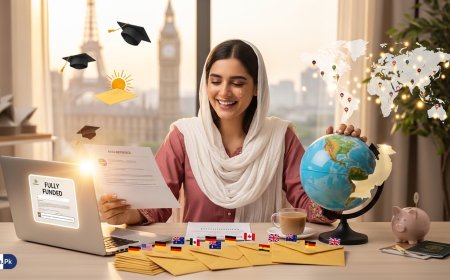







Fulbright Foreign Student Program 2026–2027 – Study in USA Fully Funded | Complete Guide
Fulbright Foreign Student Program 2026–2027 — USA's most prestigious scholarship. 4,000 grants yearly, fully funded masters and PhD. Eligibility, how to apply and tips for Pakistani applicants here.

By Sara Iqbal, Scholarships & Study Abroad Writer — March, 2026
Established in 1946 under legislation introduced by Senator J. William Fulbright of Arkansas, the Fulbright Program remains the United States government's flagship international educational exchange initiative — and the most prestigious scholarship a non-American student can receive to study in the United States.
The Fulbright Foreign Student Program enables graduate students, young professionals and artists from abroad to study and conduct research in the United States. The Fulbright Foreign Student Program operates in more than 160 countries worldwide. Approximately 4,000 foreign students receive Fulbright scholarships each year.
This is the complete guide for the 2026–2027 application cycle.
What Is the Fulbright Foreign Student Program?
The Fulbright Foreign Student Program awards approximately 4,000 grants annually to foreign students to study for a Master's or Doctorate degree and conduct research on campuses across the United States. The Fulbright Program encourages applications from all backgrounds, especially those with disabilities, to apply.
Unlike many scholarships that are administered centrally, the Fulbright Foreign Student Program is administered country-by-country through binational Fulbright Commissions or U.S. Embassies. This means the specific eligibility requirements, deadlines, and application procedures vary by your country of citizenship.
Quick Facts at a Glance
| Detail | Information |
|---|---|
| Funded By | U.S. Department of State |
| Level | Master's, PhD, Non-degree research |
| Open To | Citizens of 160+ countries (not US citizens) |
| Grants Per Year | ~4,000 |
| Coverage | Tuition, airfare, living stipend, health insurance |
| Apply Through | Fulbright Commission or US Embassy in your country |
| Deadline | Varies by country — typically February–October |
| For Pakistan | Apply through USEFP (US-Pakistan Educational Foundation) |
| Return Requirement | 2 years in home country after grant ends (J-1 visa requirement) |
Scholarship Benefits
Generally, the grant funds tuition, airfare, a living stipend, and health insurance. The Fulbright programme provides funding for the duration of the study.
| Benefit | Coverage |
|---|---|
| Tuition Fees | Fully covered at US universities |
| Monthly Living Stipend | Provided throughout the programme |
| Return Airfare | Economy class to/from USA |
| Health Insurance | J-1 Exchange Visitor insurance |
| Textbooks and Fees | Typically included |
| Pre-Academic English | Available for candidates with limited English |
| Duration | 1–2 years (master's) / up to 4 years (PhD) |
Eligibility Criteria
You must reside in the country of nomination at the time of application. At the time of programme start date, possess the equivalent of a U.S. bachelor's degree. Additional eligibility requirements differ by country of citizenship.
General Eligibility
| Criterion | Requirement |
|---|---|
| Citizenship | Non-US citizen, resident in your home country at time of application |
| Education | Bachelor's degree equivalent (or enrolled in final year) |
| English | Proficiency required — TOEFL typically needed |
| Field | Open to all disciplines including arts and creative fields |
| Previous Fulbright | Generally not eligible if previously received Fulbright, Humphrey, or JFDP |
| US Green Card Holders | Not eligible |
| US Citizens | Not eligible (separate program exists for US citizens) |
Additional Eligibility Notes
Applicants already studying in the United States are ineligible for a Fulbright grant. Applicants must receive a satisfactory medical clearance. Persons desiring permanent residence in the United States are not eligible.
Preference is given to candidates with limited prior experience in the United States and who have not previously received a Fulbright grant.
How to Apply: The Country-Specific Process
This is the most important section for applicants to understand. The Fulbright Foreign Student Program is administered by binational Fulbright Commissions/Foundations or U.S. Embassies. All Foreign Student Programme applications are processed by these offices. Programme eligibility, U.S. university admission and placement, and selection procedures vary widely by country.
For Pakistani Applicants: USEFP
Pakistani students apply through the US-Pakistan Educational Foundation (USEFP) — the binational Fulbright Commission for Pakistan.
USEFP Official Website: usefpakistan.org
Pakistan's Fulbright programme is one of the largest in the world — Pakistan consistently receives among the highest number of Fulbright grants of any country. Deadlines for Pakistani applicants typically fall in February–March for the following academic year.
For Other Countries
Use the country selector at foreign.fulbrightonline.org to find your country's specific Fulbright office and requirements.
Two Placement Models: IIE vs Self-Placement
There are two placement models for IIE's Fulbright Foreign Student Programme: IIE-Placement and Self-Placement.
| Model | How It Works | Best For |
|---|---|---|
| IIE Placement | IIE applies to US universities on your behalf, manages admissions and negotiates funding | Candidates without existing US contacts |
| Self-Placement | You identify and apply to US universities yourself | Candidates with specific institutions or advisors in mind |
Your country's Fulbright office will specify which model applies to you — in most cases it is determined by country, not candidate choice.
What Makes a Strong Fulbright Application
In your application you must describe your academic and professional goals, the programme of study you wish to pursue, and how it aligns with your background and future plans. In your personal statement, explain who you are, your motivations, the experiences that have shaped your academic journey, and how the Fulbright programme aligns with your aspirations.
The core elements of every strong Fulbright application:
1. Study Objective A clear, specific academic goal. Not "I want to study business" but "I want to study social enterprise development to build income-generating programs for displaced women in Pakistan's Khyber Pakhtunkhwa province — a field with virtually no local master's programmes."
2. Personal Statement Who you are — beyond grades. The experiences, challenges, and moments that shaped your thinking. Written in your own voice.
3. References Review instructions thoroughly and adhere to all guidelines. Proofread for grammar and spelling. Avoid plagiarism and cite sources appropriately. Use clear and concise language.
Strong references are specific to you — not generic academic reference templates. Your referee should be able to speak to your specific capabilities and why Fulbright specifically is the right programme for you at this moment.
4. English Proficiency Applicants should prepare for the TOEFL and GRE/GMAT exams. Requirements vary by country and programme — check your specific Fulbright office's requirements.
The Fulbright Interview
Shortlisted candidates are invited for an in-person interview conducted in English. The interview is conducted by a selection committee comprised of Embassy representatives, U.S. and local scholars, and Fulbright alumni.
Interview preparation should include:
- Deep knowledge of your proposed programme and why the specific US institution fits
- Ability to articulate your career plan and how Fulbright accelerates it
- Understanding of bilateral relations between your country and the USA
- Clarity on how you will contribute to your home country after returning
The J-1 Visa: What It Means for Fulbright Students
Fulbright grantees enter the United States on an exchange visitor (J-1) visa under a Department of State programme, which requires them to return to their home countries for a minimum of two years at the end of the grant period.
The J-1 two-year home residency requirement is a binding legal obligation — not a suggestion. It cannot be waived in most cases and means Fulbright is not a pathway to US immigration. It is a scholarship for students who intend to return home and contribute to their country's development.
Fulbright Fields and Subject Areas
Fulbright encourages applications from all fields, including interdisciplinary ones.
| Eligible Field | Notes |
|---|---|
| Natural Sciences | All disciplines |
| Social Sciences | Highly competitive — strong research background needed |
| Engineering & Technology | Strong STEM track |
| Business & Management | MBA typically not funded — check country specifics |
| Arts & Creative Fields | Yes — performance, fine arts, creative writing |
| Law | Yes |
| Medicine & Health | Research-focused — clinical work typically not funded |
| Humanities | All |
Candidates must be seeking a master's degree in their current field. Individuals seeking MBA, Law, or non-degree programmes are not eligible for the Long-Term English (LTE) component — though MBA/Law may be funded through the main programme depending on country.
Pakistan and Fulbright: A Special Relationship
Pakistan has one of the largest Fulbright programmes in the world. The US-Pakistan bilateral relationship has made Pakistan a priority country for Fulbright grants — Pakistani students regularly receive hundreds of scholarships annually across all academic disciplines.
USEFP manages the complete process: application, shortlisting, testing, interviews, placement, and post-arrival support in the USA. For Pakistani applicants, the USEFP website is your single most important resource — more so than the international Fulbright website.
Deadlines for Pakistani applicants typically fall in February–March for programmes beginning the following August–September.
Plagiarism: A Zero-Tolerance Policy
Please note, the Fulbright Foreign Student Programme uses a zero-tolerance plagiarism policy. Plagiarism is defined as the wrongful appropriation or publication as one's own, of the ideas, or the expression of the ideas of another. Applicants who commit plagiarism will be disqualified from the competition.
Every essay and statement must be entirely your own original writing. Do not use AI-generated text or borrow language from sample applications online. Fulbright offices specifically check for this — and disqualification means being banned from future cycles.
The Bottom Line
For Pakistani applicants: Contact USEFP immediately. Pakistan's Fulbright deadline is typically in the first quarter of the year — early February is when preparation should be complete, not when it begins.
For applicants from other countries: Use the country selector at foreign.fulbrightonline.org. Every country has its own deadline — do not assume a universal date.
For all applicants: The J-1 two-year home residency requirement is real and binding. Apply only if you genuinely intend to return home and contribute to your country after completing your studies.
External Reference: Fulbright Foreign Student Program — foreign.fulbrightonline.org
What's Your Reaction?
 Like
0
Like
0
 Dislike
0
Dislike
0
 Love
0
Love
0
 Funny
0
Funny
0
 Angry
0
Angry
0
 Sad
0
Sad
0
 Wow
0
Wow
0