





















Study in Germany for Pakistani Students 2026 – Free Tuition, Visa & Scholarships Guide
Pakistan's most complete guide to studying in Germany 2026 — free tuition universities, blocked account, DAAD scholarships, visa steps & job market
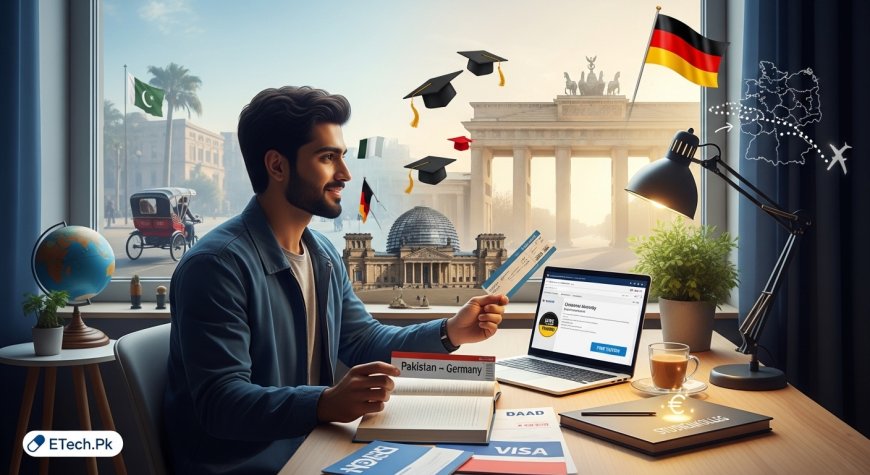
Germany charges Pakistani students zero tuition at public universities — a fact that is simultaneously well-known and poorly understood. "Zero tuition" does not mean free education. It means no per-semester academic fee at state universities. What you will pay: a semester contribution of €150–€350 (covering administration, student services, and a public transport ticket), living costs of €850–€1,100/month, and the mandatory blocked account deposit of €11,208 required for your student visa. Understanding that distinction upfront changes how you plan your finances.
Germany absorbed over 4,200 Pakistani students in the 2024–25 academic year, according to DAAD (German Academic Exchange Service) data. That number has grown 18% year-on-year for three consecutive years. This guide covers everything a Pakistani student needs — from choosing between public and private universities to navigating the blocked account, visa process, DAAD scholarship, and German job market — updated for 2026.
Public vs Private Universities: The Choice Pakistani Students Get Wrong
The zero-tuition policy applies exclusively to public (staatliche) universities. Private universities in Germany charge €5,000–€20,000/year — comparable to UK fees, without the UK's post-study work advantages. Yet many Pakistani students, misled by consultancy marketing, end up enrolled at private institutions that charge full fees.
Top Public Universities in Germany for Pakistani Students
| University | City | Strong For | Semester Fee |
|---|---|---|---|
| RWTH Aachen | Aachen | Engineering, Technology | ~€307 |
| TU Munich (TUM) | Munich | Engineering, Computer Science | ~€144 |
| LMU Munich | Munich | Medicine, Natural Sciences, Law | ~€144 |
| Heidelberg University | Heidelberg | Medicine, Life Sciences, Humanities | ~€171 |
| TU Berlin | Berlin | Engineering, Architecture, Economics | ~€315 |
| University of Freiburg | Freiburg | Environmental Sciences, Law | ~€155 |
| KIT (Karlsruhe) | Karlsruhe | Engineering, Natural Sciences | ~€232 |
Semester fees include a public transport semester ticket — effectively unlimited local travel for the semester.
Most top German public universities offer English-taught master's programmes in engineering, computer science, and business. Undergraduate degrees are predominantly taught in German. A Pakistani student planning to study at bachelor's level must commit to learning German — minimum B2 level before admission, C1 ideally before arrival.
The Blocked Account: What It Is, How Much, and Where to Open It
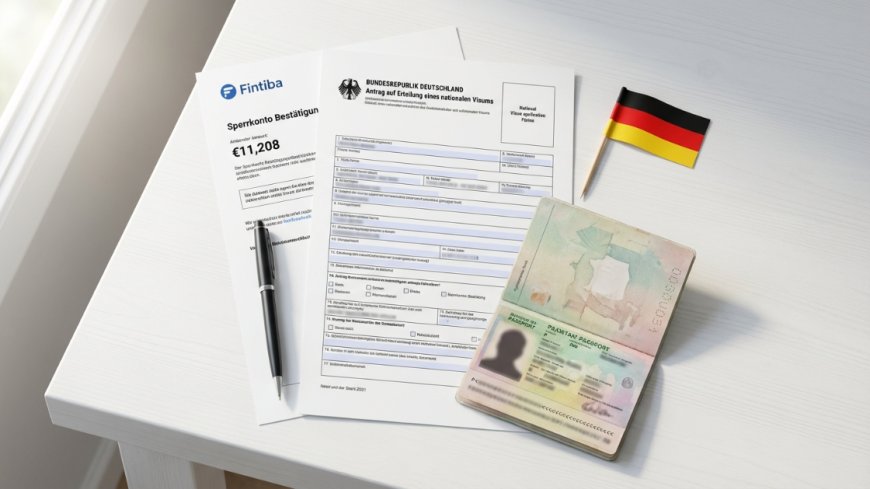
The blocked account (Sperrkonto) is not a payment to Germany — it is your own money, deposited in a German bank account, released to you at a rate of €934/month (€11,208 ÷ 12) once you arrive. It proves to the German embassy that you can fund your first year without working.
Blocked Account Providers Accepted by German Embassy Pakistan (2026)
| Provider | Setup Fee | Opening Timeline | Notes |
|---|---|---|---|
| Fintiba | ~€89 | 3–5 business days | Most popular among Pakistanis; fully online |
| Coracle | ~€79 | 2–4 business days | Good support for first-time applicants |
| Deutsche Bank | ~€35 (account fee) | 2–3 weeks | Requires in-branch visit — not practical from Pakistan |
Germany Student Visa for Pakistani Applicants: Step-by-Step
The German student visa (National Visa, Category D) is processed at the German Embassy in Islamabad and the Consulate in Karachi. In 2026, average processing time from Pakistan is 6–10 weeks. Book your appointment the day you receive your university admission letter — slots fill 8–12 weeks in advance.
- Valid Pakistani passport (minimum 12 months validity beyond intended stay)
- University admission letter (conditional or unconditional) from a German state-recognised institution
- Blocked account confirmation (Fintiba/Coracle certificate showing €11,208 deposited)
- Proof of German language proficiency (TestDaF, DSH, or Goethe-Zertifikat B2/C1) — for German-taught programmes
- IELTS/TOEFL certificate — for English-taught programmes (usually 6.5+ IELTS)
- Academic certificates: Matric + FSc/A-Level + Bachelor's (HEC attested → MOFA attested)
- APS Certificate (Akademische Prüfstelle) — MANDATORY for Pakistani applicants since 2018
- Biometric photographs (35×45mm, white background, recent)
- Health insurance confirmation (valid from arrival in Germany)
- Completed visa application form (downloaded from German Embassy Islamabad website)
- Visa fee: €75 (subject to change)
DAAD Scholarship 2026: What Pakistani Students Actually Need to Qualify
The DAAD (Deutscher Akademischer Austauschdienst) is Germany's primary scholarship body and one of the world's largest — distributing over €600 million in funding annually across 145 countries, according to DAAD's 2024 annual report. For Pakistani students, the most relevant DAAD programme is the Development-Related Postgraduate Courses (EPOS) scholarship.
DAAD EPOS Scholarship — Key Facts for Pakistani Applicants
| Detail | Info |
|---|---|
| Eligible Level | Master's and PhD programmes at German universities |
| Monthly Stipend | €992 (master's); €1,200 (PhD) — 2026 rates |
| Additional Covers | Health insurance, travel allowance, study/research allowance |
| Work Experience Required | Minimum 2 years post-graduation professional experience |
| Typical Deadline | October–November (for following year intake) |
| Application Portal | portal.daad.de |
| GPA Requirement | Upper second-class equivalent (3.0+ on US 4.0 scale) |
DAAD does not fund fresh graduates with no work experience for the EPOS programme. Pakistani students who complete a bachelor's and apply immediately are not eligible. The programme is deliberately designed for mid-career professionals from developing countries. Plan accordingly — use the 2-year work period to build the professional profile your application needs.
Separately, many German universities offer their own institutional scholarships for international students, typically in the €300–€600/month range as a supplement rather than a full replacement for the blocked account. The Deutschlandstipendium (€300/month, merit-based, university-administered) is available to enrolled students at most top universities and is underutilised by Pakistani students. [Link: suggested anchor "fully funded scholarships for Pakistani students 2026" → Top 15 international scholarships for Pakistanis]
Living Costs in Germany: City-by-City Reality for Pakistani Students
Monthly Living Cost Estimates (2026, EUR)
| City | Rent (shared room) | Food | Transport | Total Est. |
|---|---|---|---|---|
| Munich | €600–€900 | €200–€280 | Included in semester ticket | €900–€1,250 |
| Berlin | €500–€750 | €180–€250 | Included in semester ticket | €750–€1,100 |
| Aachen | €380–€550 | €170–€220 | Included in semester ticket | €600–€850 |
| Karlsruhe | €380–€520 | €160–€220 | Included in semester ticket | €580–€820 |
| Frankfurt | €520–€780 | €190–€260 | Included in semester ticket | €770–€1,100 |
Munich is Germany's most expensive student city and, counterintuitively, one of the most popular with Pakistani students due to TUM's reputation. Aachen and Karlsruhe offer comparable academic quality (RWTH and KIT are both elite technical universities) at 30–40% lower living costs. For a Pakistani family funding a student without scholarship support, that difference over four years exceeds €15,000.
Post-Study Work in Germany: The 18-Month Opportunity
Germany's updated immigration law gives international graduates an 18-month job-seeker visa after degree completion — during which you can work at any job, in any sector, at any salary, while searching for a role matching your qualification. Once you find a job meeting the skilled worker threshold (generally €45,300/year gross for 2026), you convert directly to a work permit without leaving Germany.
Pakistani engineering graduates from RWTH Aachen, TU Berlin, or KIT are actively recruited by German automotive, energy, and engineering firms. Starting salaries for bachelor's engineers in Germany average €42,000–€55,000/year gross. At current PKR exchange rates, that represents a life-changing income shift for most Pakistani families. [Link: suggested anchor "part time jobs for Pakistani students in Germany" → How Pakistani students earn while studying in Europe 2026]
Why This Matters: The Zero-Tuition Advantage Is Real, But Narrow
Germany's zero-tuition model is genuinely transformative for Pakistani middle-class families who cannot afford UK or Australian fees. But it comes with two conditions that not everyone can meet: the commitment to learning German (for bachelor's), and the capital to fund the blocked account (€11,208) plus first-year living costs simultaneously — typically a total of €20,000–€25,000 before any part-time income kicks in.
For families who can clear those two hurdles, Germany remains the single best study abroad destination for Pakistani students seeking a strong education at manageable cost with a credible immigration pathway. That calculation hasn't changed in 2026 — it's only become more favourable with the extended job-seeker visa.
The Bottom Line: Is Germany Right for You in 2026?
Germany is the right choice if: you are targeting a master's in engineering, CS, or natural sciences; you have or are willing to earn a DAAD-qualifying work experience; you can fund the blocked account; and you are willing to invest 6–12 months in German language preparation. For undergraduate study, add the German B2/C1 requirement to that list.
Apply to the APS first — before you apply to universities. Apply to German universities between December and May for the October 2026 intake. Open your blocked account as soon as you receive your admission letter. Those three steps, done in the right sequence, are the Germany process in its simplest form.
What's Your Reaction?
 Like
0
Like
0
 Dislike
0
Dislike
0
 Love
0
Love
0
 Funny
0
Funny
0
 Angry
0
Angry
0
 Sad
0
Sad
0
 Wow
0
Wow
0