





























Best Engineering Universities in Pakistan 2026 – NUST, UET, PIEAS Rankings, Fees & Placements
Pakistan's best engineering universities in 2026 ranked by QS & HEC — NUST, PIEAS, GIKI, UET fees, entry test cutoffs, and placement facts every FSc student needs.

By Ahmed Raza, Engineering Education & Tech Policy Writer — March 14, 2026
Here is a number that should reframe how you're thinking about this decision: Pakistan now has 18 universities in the QS World University Rankings 2026 UniversityGuru, and among the engineering institutions on that list, the gap between first place and fifth place in annual fees can exceed PKR 800,000. Same degree title. Very different return on investment.
This is the guide that treats you like an adult. You'll find the 2026 QS rankings, real fee breakdowns, entry test requirements, and the one thing most ranking articles skip entirely — which university is actually best for your specific engineering discipline, not just best overall.
[Link: suggested anchor "top universities in Pakistan 2026" → Overall University Rankings Pakistan 2026]
How These Rankings Were Built — And Why It Matters
Before the list, a 90-second caveat that could save you from a wrong decision.
QS evaluates universities on academic reputation, employer reputation, faculty-to-student ratio, citations per faculty, international student and faculty presence, and sustainability performance. UniversityGuru HEC's national ranking adds teaching quality, research output, and institutional governance.
Here's the counterintuitive truth no one in this space will say out loud: the QS overall rank is a poor predictor of engineering department quality for most Pakistani students. PIEAS, for example, operates more like a high-level research laboratory than a typical university, with the highest percentage of PhD faculty in Pakistan Scimago IR — yet it sits below NUST on the overall QS list simply because rankings increasingly reward scale, international diversity, and web visibility. A small, elite institution will always be disadvantaged.
The smarter move: check QS subject rankings for Engineering & Technology, not just the headline world rank. That changes the list entirely.
The Top 8 Engineering Universities in Pakistan 2026
Quick Reference Table
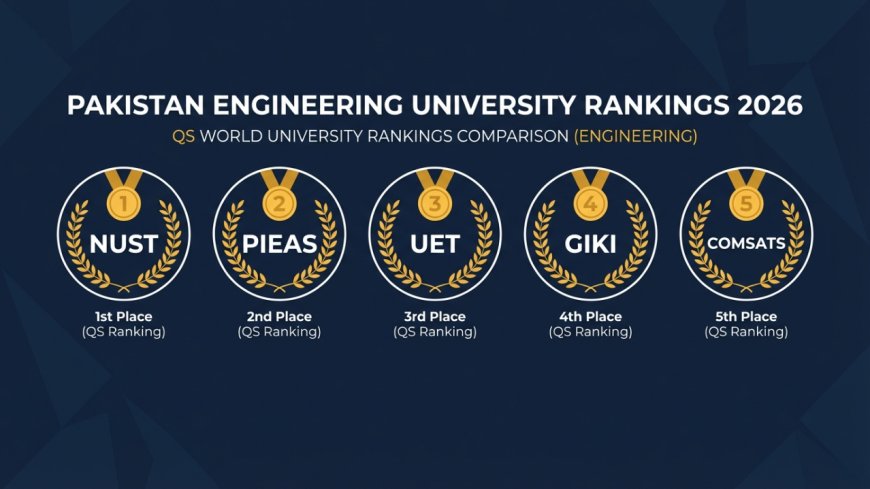
| Rank | University | QS World Rank 2026 | Type | Best For |
|---|---|---|---|---|
| 1 | NUST, Islamabad | 371 | Public | Engineering, CS, Management |
| 2 | PIEAS, Islamabad | 721–730 | Public | Nuclear, Electrical, Biomedical |
| 3 | UET Lahore | 801–850 | Public | Civil, Mechanical, Electrical |
| 4 | GIKI, Swabi | Unranked QS | Private | Mechanical, Computer, Materials |
| 5 | COMSATS, Islamabad | 664 | Public | CS, Software, Chemical Eng |
| 6 | NED University, Karachi | 1001–1200 | Public | Civil, Industrial, Architecture |
| 7 | FAST-NUCES | Unranked QS | Private | Computer Science, Software Eng |
| 8 | Air University, Islamabad | Unranked QS | Public (PAF) | Aerospace, Avionics, Electrical |
Sources: QS World University Rankings 2026 (Express Tribune, June 2025), HEC Pakistan
1. NUST — Pakistan's Top Engineering University Overall
QS World Rank 2026: #371 | QS Engineering & Technology: Top 200 Asia
NUST has built its reputation as Pakistan's leading institution for engineering, technology, and applied sciences. Top Universities Its H-12 campus in Islamabad houses state-of-the-art labs, a dedicated technology incubator (NUST Technology Transfer Office), and direct recruitment pipelines with companies including Samsung, Engro, PTCL, and government defence contractors.
NUST currently holds 160th place in Engineering and Technology (QS subject) and 67th place in Asia — and is among the top 50 universities under 50 years old globally. HEC
Strongest Engineering Programs: Software Engineering, Electrical Engineering, Mechanical Engineering, Civil Engineering, Aerospace Engineering
NUST Fees 2026 (Per Semester)
| Program | Per Semester (PKR) | Annual Estimate (PKR) |
|---|---|---|
| BE Engineering (all branches) | 100,000 – 140,000 | 200,000 – 280,000 |
| BS Computer Science | 100,000 – 140,000 | 200,000 – 280,000 |
| MS/ME | 130,000 – 180,000 | 260,000 – 360,000 |
Source: Maqsad.io fee analysis (2025–26). Fees vary by program. All fees subject to revision. The Express Tribune
Entry Requirements
Test: NET (NUST Entry Test) — three series per year (March, June, July)
Aggregate Formula: 10% Matric + 40% FSc + 50% NET Score
Minimum to be competitive: Aggregate 75%+ for popular programs. NET score 140+/200 for top branches.
Scholarships: NUST offers merit and need-based aid. Students can apply through the NUST Need Based Financial Aid Application Form (NFAAF). NUST Up to 100% fee waivers are available.
Pro tip: NUST's three-test series is a genuine structural advantage. Students who underperform in the March series can reappear in June or July. Use all three attempts if needed.
2. PIEAS — Pakistan's Most Selective Engineering Institution
QS World Rank 2026: #721–730 | Highest PhD Faculty Ratio in Pakistan
PIEAS is Pakistan's most exclusive engineering school. Administered by the Pakistan Atomic Energy Commission (PAEC), it focuses on nuclear engineering, medical physics, and laser technology. Admission is fiercely competitive, and the student body is kept intentionally small to maintain quality. Scimago IR
Its graduates are the backbone of Pakistan's nuclear energy and strategic industrial programmes. If you're the type of student who wants to work on things that genuinely matter to national infrastructure — energy, defence, advanced research — PIEAS is in a category of its own.
Strongest Programs: Nuclear Engineering, Electrical Engineering, Biomedical Engineering, Computer Science
PIEAS Fees 2026
| Program | Annual Fee (PKR) |
|---|---|
| BE (all programs) | Near-zero — full government stipend |
| MS/PhD | Stipend-based |
Government-funded. Admitted undergraduate students receive a monthly stipend covering tuition and accommodation. This is not a scholarship — it is the standard funding model for all admitted students.
Entry Requirements
Test: PIEAS Entry Test (once per year)
Requirement: FSc Pre-Engineering, typically 80%+ marks. Entry test is highly conceptual — past papers and physics fundamentals are non-negotiable preparation.
Batch size: Under 100 students per year across all programs. Among the most competitive admissions in Pakistan.
3. UET Lahore — The Mother Institution of Pakistan's Engineers
QS World Rank 2026: #801–850
UET Lahore is the "Mother Institution" of engineering in Pakistan. Its historic campus retains a massive alumni network embedded in every major infrastructure project in Pakistan — from dams to highways. Scimago IR
While NUST has taken the lead in modern rankings, UET remains a powerhouse in Civil, Mechanical, and Electrical Engineering. It has recently focused on Outcome-Based Education (OBE) to secure international accreditation. Its research centers in energy and urban planning are critical to Punjab's development. Scimago IR
UET has strong linkage with leading companies such as Siemens, Huawei, Suparco, Fast Cables, and National Transmission and Dispatch Company. HEC
Strongest Programs: Civil Engineering, Mechanical Engineering, Electrical Engineering, Chemical Engineering, Architecture
UET Lahore Fees 2026
| Program | Annual Fee (PKR) |
|---|---|
| BE Engineering | 60,000 – 130,000 |
| BS Architecture | 70,000 – 140,000 |
| MS/ME | 80,000 – 150,000 |
One of the most affordable top-tier engineering universities in Pakistan.
Entry Requirements
Test: ECAT (Engineering College Admission Test) — mandatory
Aggregate Formula: 40% Matric + 30% FSc + 30% ECAT
Minimum: FSc Pre-Engineering with 60%+ marks. Multiple campuses in Lahore, Faisalabad, Kala Shah Kaku, Gujranwala, Taxila.
[Link: suggested anchor "ECAT preparation guide 2026" → ECAT Entry Test Preparation]
4. GIKI — The Residential Engineering University That Builds Networks
HEC Ranked | Private | Swabi, KPK
GIKI is one of Pakistan's leading private engineering universities, known for its focus on innovation, entrepreneurship, and quality education. Established in 1993, GIKI is located in Topi in Swabi District, Khyber Pakhtunkhwa. Pave.pk
The fully residential model is GIKI's genuine competitive advantage. Four years living and studying in an isolated, focused environment builds the kind of peer networks that translate into career opportunities for decades. GIKI alumni dominate mid-to-senior engineering roles in multinationals across Pakistan and the Gulf.
GIKI strongly emphasises research and development, with several research centres focusing on emerging technologies such as robotics, nanotechnology, and renewable energy. Pave.pk
Strongest Programs: Mechanical Engineering, Electrical Engineering, Computer Systems Engineering, Materials Engineering
GIKI Fees 2026
| Expense | Amount (PKR) |
|---|---|
| Semester Fee (Engineering/Computing) | 427,500 per semester |
| Annual Tuition Estimate | ~855,000 |
| Admission Fee (one-time) | 63,000 |
| Security Deposit (refundable) | 30,000 |
Source: GIKI fee structure for 2025–26 session — semester fee is Rs. 427,500 for engineering/computing. Superiorcolleges Hostel and mess charges are additional.
Entry Requirements
Test: GIKI Entry Test (own test) or ECAT
Merit: FSc 85%+ recommended for competitive programs. Test is strongly conceptual in math and physics.
Note: A non-refundable admission fee of Rs. 75,000 for Pakistani applicants is required to be deposited at the time of admission. Top Universities
5. COMSATS University Islamabad — The Value Powerhouse
QS World Rank 2026: #664 | Multi-Campus | Best Value in CS & Chemical Engineering
COMSATS bridges the gap between expensive private universities and lower-quality budget options, offering internationally recognised programs at reasonable rates. SJ Academy
Its Computer Science and Software Engineering departments consistently produce graduates who transition into Pakistan's IT export sector — the fastest-growing segment of the national economy. For CS-focused engineering students who don't crack NUST's NET, COMSATS is not a compromise. It's a strategically sound alternative.
Strongest Programs: Computer Science, Software Engineering, Chemical Engineering, Electrical Engineering, Mathematics
COMSATS Fees 2026
| Program | Per Semester (PKR) | Annual (PKR) |
|---|---|---|
| BS Engineering | 85,000 – 120,000 | 170,000 – 240,000 |
| BS Computer Science | 85,000 – 120,000 | 170,000 – 240,000 |
| MS Programs | 120,000 – 160,000 | 240,000 – 320,000 |
While NUST charges approximately PKR 180,000–220,000 per semester for engineering programs, COMSATS maintains fees around PKR 85,000–120,000 for similar degrees. SJ Academy
Entry Requirements
Test: NTS-NAT (choose NAT-IE for engineering, NAT-ICS for computing)
Merit: FSc Pre-Engineering, 55%+ marks. Campuses in Islamabad, Lahore, Wah, Abbottabad, Attock, Sahiwal, Vehari.
Scholarships: The President's Merit Scholarship covers 100% tuition for students with exceptional entrance test scores who maintain a CGPA above 3.7. SJ Academy
6. NED University, Karachi — Karachi's Engineering Engine
QS World Rank 2026: #1001–1200
NED is the engineering institution that runs Karachi's industrial sector. Its civil, mechanical, and industrial engineering graduates lead infrastructure, manufacturing, and port operations firms across Sindh. Less visible nationally than NUST or GIKI, but deeply embedded in Karachi's economic fabric.
Strongest Programs: Civil Engineering, Industrial & Manufacturing Engineering, Architecture, Mechanical Engineering, Chemical Engineering
NED Fees 2026
| Program | Annual Fee (PKR) |
|---|---|
| BE Engineering | 50,000 – 110,000 |
| BS Architecture | 60,000 – 120,000 |
Entry Requirement: ECAT or UET Entry Test. FSc Pre-Engineering, 60%+. Karachi-based students have a quota advantage.
7. FAST-NUCES — Pakistan's Best University for Software Engineering
Private | Campuses in 6 Cities | HEC Ranked
FAST doesn't rank in the QS world table — but for pure software engineering and computer science, it is arguably Pakistan's strongest institution. Its graduates dominate Pakistan's software export companies, startups, and multinational tech firms. The FAST brand carries significant weight with employers in Lahore, Karachi, and Islamabad's tech ecosystems.
Strongest Programs: Computer Science, Software Engineering, Electrical Engineering, Data Science
FAST-NUCES Fees 2026
| Program | Per Semester (PKR) | Annual (PKR) |
|---|---|---|
| BS Computer Science | 100,000 – 150,000 | 200,000 – 300,000 |
| BS Software Engineering | 100,000 – 150,000 | 200,000 – 300,000 |
| BS Electrical Engineering | 110,000 – 160,000 | 220,000 – 320,000 |
Entry Requirement: FAST Entry Test (NU Entry Test). Campuses in Islamabad, Lahore, Karachi, Peshawar, Faisalabad, Chiniot-Faisalabad.
8. Air University, Islamabad — Pakistan's Gateway to Aerospace Engineering
Public (Pakistan Air Force) | HEC Ranked
Air University is the only institution in Pakistan offering dedicated Aerospace Engineering and Avionics programs at undergraduate level. If your ambition is to work in aviation, defence, or satellite technology, this is the path. It's operated under the Pakistan Air Force umbrella, which creates direct industry pathways unavailable anywhere else.
Strongest Programs: Aerospace Engineering, Avionics Engineering, Electrical Engineering, Mechanical Engineering
Air University Fees 2026
| Program | Annual Fee (PKR) |
|---|---|
| BE Engineering | 90,000 – 160,000 |
Entry Requirement: Air University Entry Test (AUAT) + FSc Pre-Engineering 60%+.
Side-by-Side Fee Comparison: All 8 Universities
| University | Annual Fee Range (PKR) | Type | Scholarship Available |
|---|---|---|---|
| NUST | 200,000 – 280,000 | Public | Yes (Merit + Need) |
| PIEAS | Near Zero | Public | Full Stipend |
| UET Lahore | 60,000 – 130,000 | Public | Yes |
| GIKI | ~855,000 | Private | Limited Merit-Based |
| COMSATS | 170,000 – 240,000 | Public | Yes (100% available) |
| NED | 50,000 – 110,000 | Public | Yes |
| FAST-NUCES | 200,000 – 300,000 | Private | Yes |
| Air University | 90,000 – 160,000 | Public (PAF) | Yes |
All fees are estimates based on 2025–26 data and subject to revision. Always verify directly with the relevant university admissions office before applying.
Entry Test Cheat Sheet: What You Need, When, and How Much It Costs
| Entry Test | Used By | Frequency | Application Fee (PKR) |
|---|---|---|---|
| NET (NUST Entry Test) | NUST only | 3x per year | ~3,000 |
| ECAT | UET, NED, GIK (partial) | Once/year | ~1,500 |
| GIKI Test | GIKI | Once/year | ~3,000 |
| NTS-NAT | COMSATS, others | Multiple dates | ~500–1,000 |
| FAST NU Test | FAST-NUCES | Once/year | ~2,000 |
| PIEAS Test | PIEAS only | Once/year | ~1,000 |
| AUAT | Air University | Once/year | ~1,000 |
Strategic note: ECAT results are accepted by multiple universities simultaneously. One test, multiple applications. Sit it regardless of whether your primary target uses it — having the score opens backup options at no extra cost.
[Link: suggested anchor "how to prepare for ECAT 2026" → ECAT Preparation Guide]
Program-to-University Matching Guide: Which School Is Best for Your Field
This is the section most ranking articles don't write. Here it is, straight:
| If You Want to Study... | Best Choice | Strong Backup |
|---|---|---|
| Software / Computer Engineering | FAST-NUCES or NUST | COMSATS |
| Civil / Infrastructure Engineering | UET Lahore | NED |
| Electrical Engineering | NUST | PIEAS or UET |
| Mechanical Engineering | NUST or GIKI | UET |
| Chemical Engineering | UET Lahore | COMSATS |
| Nuclear / Advanced Research | PIEAS | — (no comparable option) |
| Aerospace / Avionics | Air University | NUST (Aerospace Dept.) |
| Industrial / Manufacturing | NED | UET |
| Materials Engineering | GIKI | NUST |
Why This Matters: The Hidden Cost of Ranking Obsession
Every year, thousands of FSc students chase the highest-ranked university on a list — then discover at orientation that their department is a weak spot at that institution, or that 80% of their cohort is aiming for the same three companies on campus recruitment day.
As Pakistan continues to develop its infrastructure and technology sectors, the role of engineering universities will become increasingly important — not just in providing quality education but in driving research and development that contributes to national growth. Pave.pk
The real competition isn't between NUST and UET. It's between students who understand their discipline's job market and those who don't. A COMSATS CS graduate with two internships, a GitHub portfolio, and HEC-certified certifications will outperform a NUST graduate who spent four years chasing grades but skipped every industry event.
Pakistan's IT export sector crossed $3.2 billion in FY2025, with demand for software and electrical engineers far outstripping supply. The jobs exist. The question is whether you'll graduate ready to take them — from whatever university.
The Bottom Line
For top-performing FSc Pre-Engineering students: NUST remains the primary target. Sit all three NET series. Don't make it your only option.
For students who want elite quality at near-zero cost: PIEAS is the single most underrated decision in Pakistani engineering admissions. If nuclear, biomedical, or laser technology interests you, apply without hesitation.
For Civil and Mechanical engineers: UET Lahore's alumni network and fee structure make it one of the best value propositions in the country.
For Computer Science-focused students: FAST-NUCES and COMSATS both produce graduates who are immediately hireable in Pakistan's IT sector. Do not dismiss either because of a QS rank gap.
For students in Karachi: NED's local industry connections are unmatched within the city. Geography matters for your first job.
The best engineering university in Pakistan for you is the one where your chosen discipline is strong, the fees are sustainable without crippling your family, and you'll finish on time with skills employers want. Start there.
External Reference: QS World University Rankings — topuniversities.com External Reference: HEC Pakistan — hec.gov.pk
Author Bio — Ahmed Raza Ahmed Raza is an engineering education and tech policy writer whose work has appeared in TechJuice, ProPakistani, and Dawn's technology supplement, covering higher education reform, STEM policy, and Pakistan's IT export economy. He specialises in translating HEC policy and university rankings data into decisions that actual students can act on. An electrical engineering graduate himself, he sat three rounds of the NET before securing admission — which is why he writes these guides with more than academic interest. Connect with him on LinkedIn: linkedin.com/in/ahmedraza-techwriter.
What's Your Reaction?
 Like
0
Like
0
 Dislike
0
Dislike
0
 Love
0
Love
0
 Funny
0
Funny
0
 Angry
0
Angry
0
 Sad
0
Sad
0
 Wow
0
Wow
0